Fellini Blog
June 23 2026
The Soul That Dances
A Journey through the Universe of Dance in Cuba
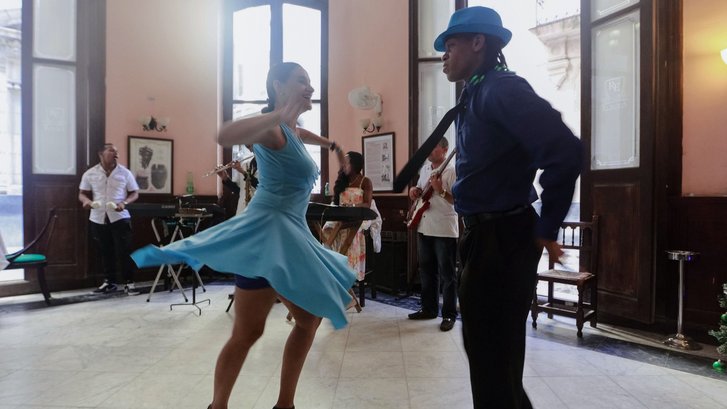
To say Cuba is to say rhythm. It is impossible to think of the island without images coming to mind of bodies moving to the beat of a clave, of feet tapping on colonial cobblestones, and of hips telling stories of resistance and joy. Dance in Cuba is not mere entertainment; it is the heartbeat of its people, a universal language that expresses their mixed-race identity and their inexhaustible vitality. "Dance is inscribed in the genetic code of Cubans, as a legacy of the fusion of African culture with Spanish culture." It is, as an old saying goes, the soul that dances.
A History that Moves to the Beat of the Centuries
Dance in Cuba is the result of a fascinating cultural melting pot, a living chronicle of the island's complex social fabric and its turbulent past. From the sacred rituals and percussive foundations of the African cultures-particularly those of Yoruba, Congo (Bantú), and Arará descent-brought forcibly during the colonial era to work the sugar and tobacco plantations, to the elegant, structured forms of European ballroom dances such as the French contredanse and the Spanish fandango, and the soulful, foot-dragging aires andaluces (Andalusian airs) brought by the colonizers from southern Spain, every single step is imbued with a layered history of encounter and resistance. This dynamic fusion, forged in the crucible of rural sugar mills, bustling port cities, and the cramped solares (tenement courtyards) of Havana and Matanzas, means that every movement on the dance floor is more than mere choreography-it is a dialogue between continents, a rhythmic negotiation that tells the story of survival, adaptation, religious syncretism, and the eventual birth of a uniquely Cuban identity. The dance floor became, in essence, a stage where the oppressed and the oppressor, the enslaved and the free, inadvertently wove together a new aesthetic language that would go on to captivate the entire world.
The First Steps: From the Areito to the Zapateo
Long before the arrival of the Spanish, the Taíno peoples who inhabited the island already practiced the areito, a ceremonial dance that combined singing, music, and movement in a circle. This ancestral tradition laid the foundations of a culture where dance and daily life have always gone hand in hand.
By the 18th century, there were already ballrooms and dance houses on the island. The Zapateo, which emerged in rural areas around 1550, is one of the first examples of Hispanic-African fusion, with its characteristic dragging of feet, possibly of Andalusian origin. In the streets of colonial Havana, the so-called "escuelitas"-dance academies that existed since colonial times-were spaces where the common people learned and passed on the rhythms of the moment.
The Birth of the Danzón: The First National Dance
At the end of the 19th century, the Danzón crystallized in Matanzas, being officially recognized as the national dance of Cuba. It was created by the Matanzas composer Miguel Faílde (1852-1921) around the year 1879, based on another Cuban genre called "la danza," a variation of the European contradanza.
The danzón emerged as a result of the transculturation of the European contradanza that arrived at the beginning of the 18th century via the Spanish courts, enriched by the migrations of French settlers and black and mulatto people from Haiti. This ballroom dance received a mixed-race influence that transformed it into Creole music, becoming the first genre to emerge in Havana.
The fascinating thing about the danzón is that, although it maintained the Afro influence in its rhythm, it possessed greater expressive freedom that allowed the couple to embrace with more sensuality. From the beginning of the 20th century, the danzón had great roots not only in Cuba but also in Mexico, where it remains part of popular culture. It was performed mostly with wind instruments: flute, violins, timbales, and Cuban percussion.
The Golden Age and Worldwide Expansion
At the beginning of the 20th century, the Son Cubano-which combined the structure of Spanish music with Afro-Cuban and indigenous elements and instruments-began to gain ground. The first sones emerged in eastern Cuba at the end of the 19th century, and by the early 1930s, the son was the most influential musical genre and dance in Cuba.
The son was initially considered "inferior music" and an "indecent dance" by the elites, but its popularity among the common people was unstoppable. La Sonora Matancera, one of the most acclaimed groups, brought the son to the highest social circles when President Gerardo Machado invited them to his birthday party. Cuban son achieved international projection from the 1930s onward, conquering the world.
The Rhythms that Move the World
To speak of Cuban dance is to speak of a family of rhythms as varied as the island itself. "Cuba is one of the countries that has contributed the most danceable genres to the list of international dances." Each one has its flavor, its character, and its way of telling life.
The Son Cubano: The Root of Everything
The son is the root. Almost all other genres draw from it. Its cadence and the dialogue between the guitar and the tres create the musical foundation upon which the couple's dance is built, intimate and full of "sabor" (flavor). It is a partner dance and a musical genre original to Cuba, whose first manifestations are recorded from the 18th century onward, associated with festive environments. It is, without a doubt, the backbone of Cuban music and dance.
The Rumba: Heritage of Humanity
The Rumba is not a single dance, but a complex of rhythms, which includes the Guaguancó, the Columbia, and the Yambú. It emerged during Spanish colonialism while the sugar expansion was taking place, led by free black people and their descendants belonging to different African ethnic groups such as Lucumí, Ganga, Arará, and Gangá-Bantú.
The rumba was typically an Afro-Cuban folk dance that served as a fertility dance, taking its bases for ballroom dance in the 17th century from the Cuban son. The Guaguancó, the most developed variant, is a dance from the black neighborhoods that represents the male's courtship of the female, generating the sensual movements that characterize the salsa dancer. The Columbia has a more pugilistic origin, with dances attributed to the Congos known as "baile de maní" (peanut dance), which could be considered very primitive rumbas.
The Chachachá: The Rhythm that Conquered the World
The Chachachá is a Cuban musical rhythm and a popular dance style that was developed from the danzón-mambo in the early 1950s. It was created by Cuban violinist and orchestra director Enrique Jorrín, who, seeing the difficulties that white people had dancing the mambo, invented this new rhythm: "for the Cubans who don't know how to mambear."
Jorrín took the danzón as his base and, with his orchestra América, played "La Engañadora" in 1953 in a Havana ballroom, giving rise to a phenomenon that quickly spread throughout the world. The chachachá became a globally recognized Latin dance.
The Casino (Cuban Salsa): The Dance of the Revolution
The Casino is the emblematic partner dance of Cuba, born in Havana in the 1950s from figures of son, cha-cha-chá, and mambo. The name comes from the "casinos deportivos"-social clubs and dance halls in Havana where the style took shape.
The casino emerged as an anonymous dance manifestation, within the urban popular classes. It does not correspond to any specific musical genre; it is a dance for individual and collective fun, and its contemporary dynamic is reflected in the great creativity and freedom of its body and spatial movements. This dance style strongly reflects today the very character of the Cuban people, constituting a synthesis of the traits that characterize us.
The casino is currently the most thriving and relevant ballroom dance, a sociocultural event that has directly influenced the development, creativity, and diversity of danceable music in Cuba. It is danced in pairs or in groups, mixing influences from African and European dances through the fusion of son, son montuno, rumba, and guaracha.
The Rueda de Casino: The Circular Party
The Rueda de Casino is perhaps the most visual and festive expression of Cuban dance. Several couples form a circle and execute synchronized steps to the call of a "singer." The Rueda de Casino is different from other salsa styles due to its spontaneous use of the rich movement of Afro-Cuban dance; a Casino dancer frequently improvises references to other dances, integrating movements, gestures, and extensive passages from the folkloric and popular legacy.
Other Rhythmic Treasures
Cuba has also given the world other equally fascinating rhythms. The Sucu-Sucu, a dance and peasant tune from the Isle of Youth (formerly Isle of Pines), became a new rhythm in 1946 thanks to promoter Eliseo Grenet. It is a variant of son, whose origin is located at the end of the 19th century, and it constitutes one of the basic forms within the music of the Isle.
The Cradle of Talent: Schools and Masters
Cuba is a talent factory. Dance training is a national priority, and its institutions are recognized worldwide.
The National Ballet of Cuba: A Heritage of the Nation
The National Ballet of Cuba (BNC) is one of the most prestigious dance companies in the world. It was founded on October 28, 1948, under the name Ballet Alicia Alonso, by Alicia Alonso, Fernando and Alberto Alonso. In 1950, the National Ballet School Alicia Alonso was created, attached to the professional company, the first of its kind in Cuba, where the new figures of Cuban ballet would be forged from then on.
For seven decades, the company was led by Prima Ballerina Assoluta Alicia Alonso until her death in 2019, at which point another great Cuban dancer, Viengsay Valdés, took over the direction. The company has been considered, since 2018, as "Cultural Heritage of the Nation," being recognized as "the maximum expression of the Cuban ballet school, which has achieved its own physiognomy where the tradition of theatrical dance merges with the essential features of the National Culture."
The best dancers from Cuba have passed through its ranks. The so-called "Four jewels of Cuban ballet" (Loipa Araújo, Josefina Méndez, Mirta Plá, and Aurora Bosch) shone for decades with the BNC. Today, the BNC continues to have a solid corps de ballet, where the principal dancers Sadaise Arencibia, Anette Delgado, Grettel Morejón, Dani Hernández, and Rafael Qenedit stand out.
Danza Contemporánea de Cuba: Six Decades of Vanguard
The company Danza Contemporánea de Cuba has remained active for six decades. Founded by maestro Ramiro Guerra, great Cuban dancers and choreographers have passed through it, all National Dance Prize winners such as Santiago Alfonso, Eduardo Rivero, Rosario Cárdenas, and its current director, Miguel Iglesias. It has performed on stages in more than 90 countries and has taken part in the most prestigious festivals on the planet, receiving praise from figures such as Antonio Gades, Cristina Hoyos, and Mikhail Baryshnikov.
Lizt Alfonso Dance Cuba: Fusion and International Prestige
Created in 1991 by teacher Lizt Alfonso, this company has performed on prestigious stages such as the City Center in New York, the New Victory Theater on Broadway, the Shanghai Oriental Art Center, the Oude Luxor Theater in Rotterdam, and the Cairo Opera House.
Acosta Danza and Malpaso: New Generations
Acosta Danza, founded by the legendary dancer Carlos Acosta, and Malpaso Dance Company, a contemporary dance company based in Havana and associated with the Joyce Theater in New York, represent the vanguard of Cuban dance, fusing modern trends with the best of Cuban dance.
Schools for Everyone
In addition to professional institutions, there are multiple spaces for both tourists and locals to immerse themselves in Cuban rhythms. La Casona del Son is considered one of the highest-level Cuban dance schools in Havana. Salsa en Clave offers excellent salsa classes and other Cuban rhythms such as son, rumba, cha cha cha, and Afro. Casa Cuba offers workshops, masterclasses, regular classes, and complete training for all audiences.
Conclusion: The Island that Never Stops Dancing
Cuba is, without a doubt, one of the world capitals of dance. Its history, its people, and its music intertwine in a perpetual dance that invites everyone to participate. Whether through the elegant steps of the danzón, the overflowing energy of the rueda de casino, the sensuality of the guaguancó, the elegance of the chachachá, or the precision of classical ballet, the island offers a rhythmic universe that captivates anyone who lets themselves be carried away by its beat.
UNESCO has recognized it: Cuban rumba is Intangible Cultural Heritage of Humanity, a testimony to the richness and depth of this tradition. And the National Ballet of Cuba is Cultural Heritage of the Nation.
If you ever have the opportunity to set foot on Cuban soil, do not think twice: let yourself be carried away by the music, find a dance partner, and join the party. Because in Cuba, as they say, he who doesn't dance, doesn't feel.
Related Blogs